.jpg?width=50&name=Shobana_Anpalagan_Profile%20(1).jpg)

In the healthcare sector, supply chain management is far more than an operational cost center; it...
According to an industry analysis by NetSuite, supply chain management in the healthcare industry frameworks emphasizes the strategic coordination of procurement and distribution of the goods required to sustain both business operations and the care of patients.
Unlike industries that can zero in on a narrower range of related products, a healthcare supply chain needs to account for particularly stringent regulatory and compliance standards and could include everything from pens, laptops, and printing paper to perishable drugs and blood, X-ray machines, and surgical implants.
Each healthcare organization must manage a broad network of vendors, processes, systems, and data to guarantee that partners manufacture, deliver, store, and use these items to advance premium, cost-effective patient care.

Image source: Shutterstock
Given the supply chain’s critical importance to a health system’s financial resilience and clinical outcomes, moving away from fragmented, paper-based workflows is a necessity.
Market research from MarketsandMarkets projects that the global supply chain management in the healthcare industry market will reach USD 5.06 billion by 2030, as an industry-wide shift toward cloud platform integration and automated tools rapidly drives this growth.
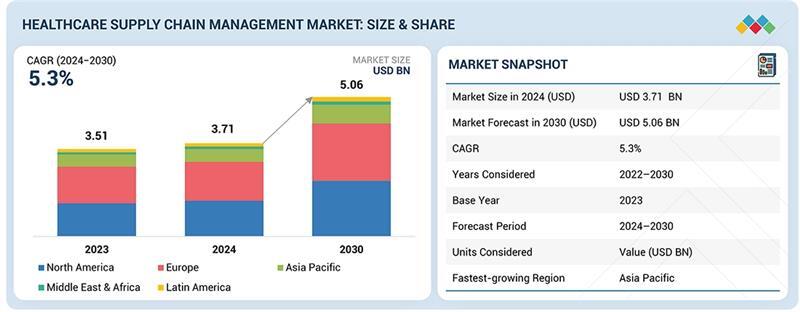
Image source: MarketsandMarkets
To safeguard thin operating margins against ongoing market changes, healthcare executives must elevate their procurement strategy from a back-office operation into an enterprise-wide priority.
1. How Can Data Quality and System Integration Eradicate Legacy Gaps?
Data forms the core of modern logistics, yet disconnected record-keeping still burdens many healthcare providers.
When baseline healthcare inventory management relies heavily on manual interventions, phone calls, or faxed requests, substantial blind spots emerge.
Phone orders often omit standardized product tracking codes, and staff can easily misplace paper delivery confirmations before entering them into digital systems, creating severe gaps in asset monitoring.
Transitioning to a truly strategic framework requires a rigorous focus on data hygiene and platform integration. Forward-thinking healthcare systems are adopting a structured approach to prevent these operational leaks:
- Establishing Data Governance: Creating formal protocols to audit and enforce data quality metrics across all clinical and operational departments, ensuring every department uses the same definitions.
- Standardizing Digital Formats: Migrating data into uniform architectures to facilitate instant reporting, reduce human error, and streamline cross-vendor coordination.
- Deploying Enterprise Cloud Software: Centralizing data silos into cloud-based ERP solutions to unify purchasing, financials, and healthcare inventory management software within a single, real-time dashboard
The Executive Connection:
Bridging these internal operational silos and modernizing legacy infrastructures requires coordinated leadership at the absolute highest level.
This exact intersection of technology governance and operational efficiency will be a major focus for health system leaders collaborating at the upcoming Marcus Evans Healthcare CEO Summit this October.
2. Elevating End-to-End Supply Chain Visibility
Unanticipated disruptions are an ongoing reality in healthcare logistics, but a reactive stance severely exacerbates their impact.
Maximizing visibility across the entire supplier network, both within internal facilities and across the external distributor channel, is paramount for insulating organizations against manufacturing bottlenecks and shipping delays.
Achieving complete network transparency depends on deploying automated identification and data capture tools. Utilizing barcodes, RFID scanners, and IoT devices allows procurement teams to monitor inventory movement in real time from the moment a shipment lands to its ultimate use at the point of care.
Furthermore, integrated supplier portals give leadership a direct line of sight into vendor manufacturing schedules, letting hospital executives adapt proactively before a supply deficit reaches a critical frontline unit.
3. Mastering Predictive Demand Forecasting and Inventory Control
Maintaining balanced inventory levels ensures a health system has immediate access to critical care items without tying up vital working capital in costly, stagnant overstock.
This balance is uniquely difficult within the healthcare sector, where inventory frequently features highly sensitive, perishable materials like blood products, vaccines, and specialized biologics that carry strict compliance safeguards and high risks of spoilage.
Strategic organizations are combating this risk by shifting toward predictive analytics and demand-sensing technologies. Reliable demand forecasting models look at utilization historical patterns to predict exactly what supplies a clinical team will need during specific periods.
By evaluating broader network designs, including supplier facilities, local distribution centers, and transportation channels, procurement leaders can identify latent bottlenecks and balance buffer stocks long before disruptions compromise patient care.
4. How Do We Navigate the Roadblocks to Strategic Transformation?
Shifting from a reactive loop to a proactive asset is a cultural challenge just as much as a technical one. Healthcare executives frequently run into predictable hurdles when executing this blueprint:
- Clinical Resistance to Standardization: Surgeons and specialized physicians often prefer specific, high-cost vendors for medical devices. Strategic procurement must collaborate with clinical leaders to balance preferences with cost-effectiveness.
- Fragmented Tech Adoption: Upgrading to a new cloud ERP platform fails if frontline loading dock workers or nursing staff skip the digital entry steps. Continuous training is vital to ensure end-to-end data hygiene.
- Vendor Compliance Variances: Smaller regional suppliers may lack the advanced tracking software required to connect to a hospital's centralized portal, requiring flexible onboarding phases.
Frequently Asked Questions
What is reactive vs. strategic supply chain management in healthcare?
Reactive procurement relies heavily on manual tracking, faxed communications, and siloed data, which can lead to sudden inventory shortages or costly overordering. Strategic management leverages cloud integration, predictive forecasting, and automated data capture to maintain optimal inventory levels and protect operating margins.
How does poor data quality impact healthcare logistics and inventory?
When systems depend on fragmented inputs like uncodified phone orders or paper logs, it introduces widespread tracking errors. This lack of standardization leads to blind spots in core healthcare inventory management metrics, higher invoice discrepancies, and potential disruptions in clinical workflows.
Why is predictive demand forecasting vital for clinical supplies?
Many healthcare assets, such as vaccines, blood products, and specific pharmaceuticals, are highly perishable and temperature-sensitive. Accurate demand forecasting helps predict precise usage windows, ensuring these lifesaving materials are readily available without causing expensive overstock waste or spoilage.