
High voltage electrical safety requires strong controls for arc flash, electric shock and earthing hazards. It also depends on competent personnel, clear procedures and regular checks.
This article provides executives and safety leaders with a practical framework for reviewing high voltage safety assessments, switching procedures, training and risk controls. It is intended for management oversight and does not replace approved procedures or technical instructions for electrical work.
These issues will also be explored at the High Voltage Electrical Safety, Maintenance, Design & Commissioning Conference, where industry professionals will discuss key challenges, practical approaches and developments in high voltage electrical safety, maintenance, design and commissioning.
What Governance Does High Voltage Safety Require?
Effective high voltage safety starts with clear accountability, documented procedures and properly trained and authorised personnel.
In Victoria, high voltage installations must be safely operated and maintained, supported by written procedures and appropriately trained personnel. Requirements can vary between jurisdictions, so organisations should confirm the rules that apply to their specific location. Energy Safe Victoria – High Voltage Safety Standards
Organisations should:
- Assign an executive sponsor and technical authority.
- Keep electrical drawings and maintenance plans up to date.
- Clearly define contractor responsibilities.
- Review emergency arrangements regularly.
- Track outstanding corrective actions and assign clear owners.
When corrective work is delayed, document the risk, temporary controls, responsible person and expected completion date.
Building an Arc Flash Hazard Assessment
An arc flash hazard assessment should identify potential electrical hazards, the tasks that could expose workers and the controls needed to reduce the risk.
Arc flash can occur because of equipment failure, insulation damage, incorrect test equipment or accidental contact with energised parts. It is not limited to high voltage installations. WorkSafe Queensland – Electrical Safety Guidance
A competent specialist should review the electrical network information and document the assumptions used in the assessment.
Queensland guidance references methods such as IEEE 1584 and ENA NENS 09 for estimating incident energy. The assessment should also explain why the selected method is suitable and when it should be reviewed. WorkSafe Queensland – Guide for Safe Working on or Near Energised Electrical Equipment
What Does Arc Flash Incident Energy Mean?
Arc flash incident energy refers to the thermal energy that can reach a person or surface at a specified distance during an arc fault. It is commonly expressed in cal/cm².
The result can be affected by factors such as:
- Fault current
- Protection clearing time
- Working distance
- Equipment configuration
An incident-energy result should be used as part of a wider safety assessment. It should help inform work methods, boundaries and PPE requirements rather than being treated as the only measure of risk. Energy Safe Victoria – Arc Flash Hazard Management Guideline
Management should also confirm that protection settings, equipment condition and proposed work remain consistent with the assessment.
Applying the Electrical Safety Controls Hierarchy
Where possible, de-energisation and effective isolation should take priority over relying on PPE.
Queensland guidance requires electrical equipment to be de-energised before electrical work is carried out on or near it, subject to specific exceptions for energised work. WorkSafe Queensland – Electrical Safety Guidance
Use these electrical safety checks as management review points:
- Can the exposure be eliminated through isolation or work scheduling?
- Can equipment or protection systems be improved?
- Are barriers and access restrictions suitable?
- Are the required PPE, tools and testing equipment available?
- Are workers appropriately trained and authorised?
Strengthening HV Switching Procedures
HV switching procedures should provide clear, equipment-specific instructions based on approved operating arrangements.
Victorian guidance highlights the need to consider circuit conditions before switching, avoid unsafe operation and confirm correct operation wherever practicable. Operators must also be protected from hazards such as electric shock and arc flash. Energy Safe Victoria – The Blue Book
Good switching governance should include:
- Clear equipment identification
- Defined authorisation limits
- Communication procedures
- Stop-work criteria
- Accurate drawings and labels
- Confirmation that equipment matches the approved documentation
Any differences between drawings, labels and actual equipment should be resolved before the work is approved.
Integrating Earthing and Bonding
Effective high voltage earthing and bonding requires more than confirming that an earth connection exists.
Design performance should be supported by inspection, testing and documented results. Energex guidance includes activities such as continuity testing, soil resistivity testing, earth potential rise assessment, and touch and step voltage testing. Energex – Earthing Technical Guidance
Organisations should also review the earthing system when equipment, fences or other conductive infrastructure changes.
Keep design assumptions, commissioning results and maintenance records together so that the current condition of the system can be demonstrated.
Temporary operational earthing should also remain subject to approved HV access procedures and should not be confused with permanent installation design. Energex – Earthing Technical Guidance
Addressing Touch and Step Potential Substation Risks
Touch and step potential can create serious risks during an earth fault.
Touch potential can occur when a person contacts a conductive object while standing on the ground. Step potential refers to voltage differences between the points where a person's feet are positioned.
Transferred voltages can also create risks through conductive services that extend beyond the immediate substation area. Energex – Earthing Technical Guidance
An earthing assessment should consider accessible areas and nearby conductive infrastructure, not just equipment inside the substation fence.
Testing should be supported by documented acceptance criteria appropriate to the installation. Energex – Earthing Technical Guidance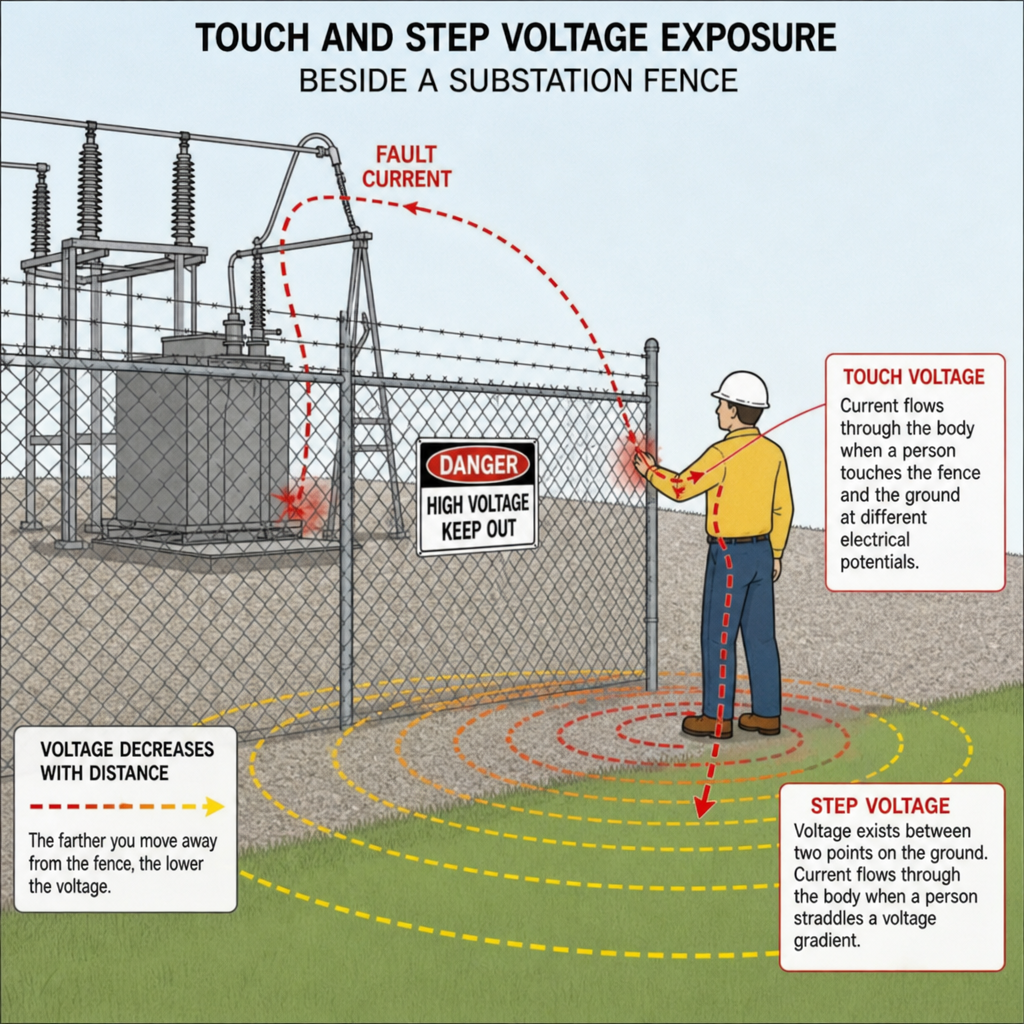
Image Source: Generated by AI (SEMrush)
Learning From HV Switching Incidents and Near Misses
HV switching incidents and near misses can reveal weaknesses in procedures, communication and organisational controls.
Investigations should look beyond individual mistakes and consider questions such as:
- Was the procedure clear?
- Was the correct equipment identified?
- Were communication arrangements effective?
- Were workers properly authorised?
- Were drawings and labels accurate?
- Did organisational pressures influence the decision?
Corrective actions should address the underlying problem and include a method for verifying that the improvement has worked.
A Queensland safety alert describes a worker being burned during HV equipment work in 2025. The alert also makes clear that its initial findings were unconfirmed. Incident information should therefore be used carefully: preliminary findings can support learning and review but should not be presented as confirmed causes. WorkSafe Queensland – Electrical Safety Guidance
Training and Competency
High voltage safety training should reflect the worker's actual responsibilities, equipment and authorisation requirements.
When evaluating arc flash training in Australia, organisations should look beyond attendance certificates. Consider whether the training provides relevant practical assessment, technical knowledge and site-specific application.
Training should support an organisation's broader competency management system rather than replace it.
For professionals looking to strengthen their knowledge of high voltage safety, electrical safety, arc flash and earthing, the High Voltage Electrical Safety, Maintenance, Design & Commissioning Conference provides an opportunity to learn from industry specialists and discuss current challenges and practices.
Explore the conference agenda to review the topics and sessions covered.
KPIs for Executive Assurance
Organisations should use leading indicators alongside incident statistics to understand whether high voltage safety controls are working.
Useful measures include:
- Overdue protection maintenance and earthing defects
- Assessments awaiting review following plant changes
- Operators awaiting competency reassessment
- Outstanding corrective actions
- Corrective actions closed with effectiveness verification
Each KPI should have a clear owner, evidence source and escalation threshold.
High-risk overdue actions should be reviewed individually rather than allowing an overall completion percentage to hide important gaps.
Executive High Voltage Safety Checklist
Before accepting a high voltage safety assurance report, confirm that:
- Accountable technical and executive owners are identified.
- Electrical assessments reflect current equipment and operating conditions.
- Switching, isolation and earthing arrangements are documented.
- Workers have the required competency and authorisation.
- Emergency arrangements have been tested and reviewed.
- Critical corrective actions have clear owners and completion plans.
- Changes to equipment or infrastructure trigger appropriate reassessment.
Strengthen Your High Voltage Safety Knowledge
High voltage safety requires continuous review as equipment, regulations, technology and operating conditions change.
The priority for executives and safety leaders should be clear: identify the risks, verify the controls, close critical gaps and make sure improvements are sustained.
Interested in learning more from industry experts?
View the High Voltage Electrical Safety Conference and explore the latest programme covering high voltage safety, electrical maintenance, design, commissioning, arc flash and earthing.
For conference details, participation options or enquiries, contact the Marcus Evans team