
HV Testing, Commissioning & Substation Design
High-voltage (HV) substation commissioning confirms that equipment and electrical systems are installed correctly and ready for safe operation. It involves inspections, electrical testing, protection checks and documented acceptance—not just a final test before energisation.
For asset owners and project teams, the goal is simple: prove that each piece of equipment works correctly and that the complete system performs as designed. (NETA)
These will also be explored at the High Voltage Design, Testing, Maintenance & Commissioning 2027 Conference, where industry professionals will discuss key challenges, practical approaches and developments in high voltage electrical safety, maintenance, design and commissioning.
How Does Commissioning Influence Substation Design?
Commissioning should be considered during the design stage, not only after construction. Test requirements, acceptance criteria, access arrangements and responsibilities should be defined before equipment is purchased and installed.
This gives designers, contractors and operators a clear basis for confirming that the completed substation meets project requirements. (NETA)
For 275 kV substations, the design should consider:
- Equipment access and isolation
- Protection and control interfaces
- Testing requirements and outage planning
- Construction and commissioning stages
- Acceptance criteria and guaranteed values
These requirements should be included in the inspection and test plan so commissioning teams know what needs to be tested and what results are acceptable. (Transgrid)
Large transmission projects also show why interface management is important. Western Power's transmission programme, for example, includes new substations, transformers, terminals and modifications to existing infrastructure. Clear ownership of these interfaces can help prevent commissioning delays. (Western Power)
[Substation lifecycle showing design reviews, factory tests, site tests and energisation approval]
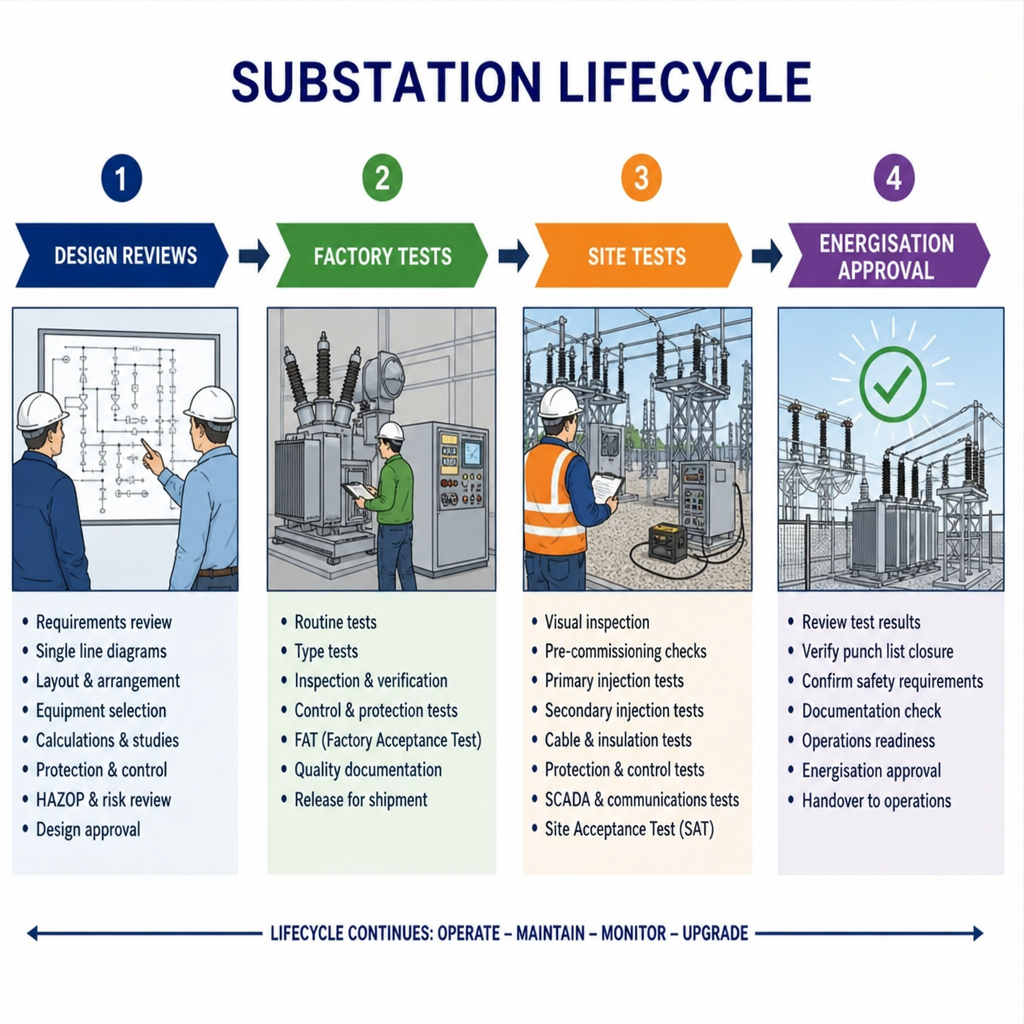
Image source: Semrush AI tool
FAT and SAT: Why Both Matter
Factory Acceptance Testing (FAT) and Site Acceptance Testing (SAT) provide different types of evidence.
FAT confirms that equipment meets agreed requirements before it leaves the manufacturer.
SAT confirms that the equipment has been installed correctly and operates as required at the actual site.
FAT does not replace site testing. Equipment can be affected by transportation, installation, wiring and site conditions, so its performance must be verified again after installation. (NETA World)
Each test record should clearly identify:
- The equipment being tested
- The test procedure
- Acceptance criteria
- Test results
- Defects or outstanding issues
- Person responsible for approval
Keeping this information together creates a clear evidence trail from factory testing through to final commissioning. (NETA)
What Should Pre-Energisation Testing Cover?
Before energisation, the commissioning team should confirm that equipment is installed correctly, is in good condition and operates as intended.
A complete programme should combine physical inspections, equipment testing and functional checks. Passing an individual equipment test does not automatically prove that the complete substation is ready for service. (NETA ATS)
Installation Checks
Inspect equipment, connections, identification, mechanical operation and installation quality against approved drawings and manufacturer requirements. Any defects should be documented and resolved before energisation. (NETA ATS)
Transformer Testing
Depending on the transformer and project requirements, testing may include:
- Insulation resistance
- Winding resistance
- Turns ratio
- Excitation current
- Oil testing
Results should be compared with approved acceptance criteria and relevant factory test records. (TasNetworks)
Switchgear Testing
Switchgear should be checked for correct mechanical operation and specified electrical performance after installation. Test results should be recorded against the required values and tolerances. (Transgrid)
Protection Testing
Protection testing should clearly distinguish between primary injection and secondary injection.
Primary injection tests the primary circuit and associated instrument transformers and wiring. Secondary injection applies test signals at the secondary level to check relay operation, settings and logic.
Both methods have an important role, but neither should automatically be treated as proof that every protection function has been fully verified. (SMC)
HV Cable Testing
Underground HV cables should have a dedicated testing and commissioning plan covering the applicable sheath, insulation and diagnostic tests.
The selected test method should match the cable system, project requirements and applicable standards rather than simply the test equipment available. (OMICRON)
GIS and AIS Need Different Test Approaches
GIS and AIS substations should follow the same overall principle of proving equipment is safe and fit for service, but their testing requirements are different.
For GIS, commissioning may include manufacturer-approved assembly checks, gas-system checks and dielectric testing.
For AIS, testing should focus on exposed connections, insulation condition, mechanical installation and equipment-specific acceptance requirements. (NETA ATS)
Where required, partial discharge testing can provide additional information about insulation condition. For GIS, UHF-based partial discharge measurements can help identify potential defects during commissioning and troubleshooting. Recording the test setup and background noise also makes future comparisons more useful. (OMICRON)
Safety Must Be Part of the Commissioning Process
Commissioning is not complete simply because the equipment passes its electrical tests. The project must also meet applicable safety requirements and have clear procedures for releasing equipment into service.
For example, Queensland's Electrical Safety Regulation 2026 commenced on 1 September 2026, with certain safety-management-system provisions commencing later. Project teams should review their procedures against the requirements that apply to their work. (WorkSafe Queensland)
Safety reviews should also consider lessons from actual incidents, including high-voltage arc-flash events. (WorkSafe Queensland)
Additional industry discussions on switchboard and battery-storage safety can also help teams identify wider project risks. (Utility Magazine) (Energy Magazine) (RenewEconomy)
For battery-connected projects, however, battery-system acceptance should remain separate from substation acceptance, with clear responsibility for the interfaces between the two systems.
What Should Happen When a Test Fails?
An unexpected result should lead to an investigation—not repeated testing until the equipment passes.
Before declaring equipment defective, check:
- Test equipment and calibration
- Test connections
- Equipment configuration
- Test conditions
- Approved procedures
- Previous factory and site results
Instrument transformers should also be assessed as part of the complete protection system rather than only as individual components. (OMICRON)
Before the substation is released for service, require:
- Investigation of abnormal results
- Correction of identified problems
- Retesting of affected equipment or functions
- Approval of final test reports
- Confirmation of protection settings
- Clear ownership of any remaining actions
These steps create clear acceptance gates before energisation. (NETA)
Turn Commissioning Requirements Into Better Project Controls
Effective HV testing and commissioning starts long before the first site test. Design teams, contractors and asset owners should agree on acceptance criteria, testing responsibilities, documentation and interface requirements early in the project.
For professionals looking to explore practical approaches to HV testing, commissioning, protection, maintenance and substation design, take a look at the 6th Annual High Voltage Design, Testing, Maintenance & Commissioning 2027.
If you would like to discuss whether the programme is relevant to your team, enquire about the conference . To view the full agenda or more conference details, contact Sanjida Akter at sanjidaa@marcusevanskl.com
Key Takeaway
Good commissioning begins at the design stage. Define acceptance requirements early, test equipment systematically, verify the complete system and resolve abnormal results before energisation.
A clear evidence trail gives asset owners greater confidence that the substation is safe, compliant and ready for reliable operation.