
Packaging leaders must control material costs, protect products, meet brand requirements, and improve sustainability, often while working with tighter budgets and complex supply chains. Artificial intelligence (AI) offers new ways to improve packaging decisions, from design and material selection to production inspection and fulfillment.
AI to optimize packaging means using software to improve specific decisions across packaging design, engineering, and manufacturing. These applications can help companies compare design options, identify quality issues, reduce unnecessary material use, and select packaging that suits the product and its distribution requirements.
However, AI does not guarantee cost savings or better packaging performance. Results depend on data quality, the suitability of the application, and the company's ability to validate recommendations before production.
For senior packaging executives, the priority is to identify where AI can solve a measurable business problem without compromising product protection, quality, regulatory compliance or customer experience. Join us at the upcoming AmericaPack Summit 2027 to discover how industry leaders are leveraging AI, cutting-edge packaging innovations, and sustainable technologies.
Where AI in Packaging Can Improve Business Performance
AI in packaging covers several applications, each with different costs, requirements, and potential benefits.
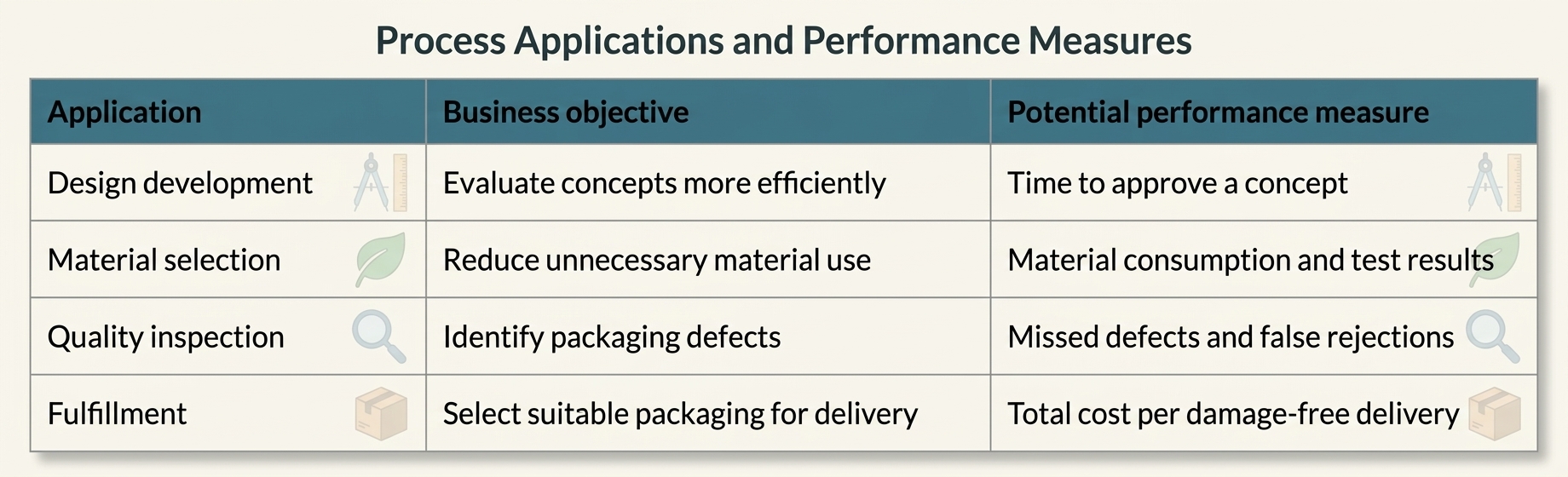
Image source: AI-generated using OpenAI
These measures give executives a starting point for evaluating AI investments. Each application needs a clear owner, a documented baseline, and measurable acceptance criteria.
For example, reducing packaging weight may appear beneficial until the lighter structure causes product damage, customer complaints, or retailer chargebacks. Companies must assess the full business outcome rather than material savings alone.
1. AI for Packaging Design and Material Selection
Packaging design must balance brand presentation, technical requirements, product protection, and manufacturing constraints. AI can support early design exploration by generating visual concepts and helping designers compare alternatives before committing resources to detailed development.
Adobe has described how Mattel designers used Adobe Firefly to explore visual directions and colour ideas for Barbie packaging. The example shows how generative AI can support creative development while designers retain responsibility for refining and approving the final work. Read Adobe's account of the project.
For packaging leaders, the value lies in exploring more options without weakening brand control. AI-generated concepts still require checks for brand consistency, artwork accuracy, production feasibility and intellectual property considerations.
AI-assisted analysis may also help packaging engineers compare material options against cost, weight, strength, barrier properties and product protection requirements.
Consider a company reviewing the packaging for a high-volume product. A lighter structure could reduce material consumption and freight weight, but only if it protects the product during storage, handling and delivery. AI may help narrow the options, while engineering tests determine whether an alternative performs adequately.
Right-sizing offers another opportunity. Better use of product dimensions and packaging specifications can help reduce unnecessary space and material. However, the selected package must still accommodate protective inserts, production tolerances and distribution conditions.
Packaging Corporation of America discusses these opportunities in its overview of AI in packaging, including efficiency, sustainability and innovation.
AI can support design decisions, but it cannot replace the physical validation required before a new package enters production.
For a closer look at design-stage applications, read our article on How AI Is Transforming Packaging Design, which explores how generative AI, virtual prototyping and design evaluation can help packaging leaders compare concepts before committing to physical samples.
2. Using AI to Support Sustainable Packaging Decisions
Reducing material use does not automatically make packaging more sustainable. Packaging leaders must also consider product protection, material composition, recyclability, transport requirements and the infrastructure available to manage packaging after use.
AI can help compare packaging options by analysing product characteristics, material specifications and delivery outcomes.
Amazon's Package Decision Engine provides an example of how data and AI can support packaging selection. The system uses product information and delivery feedback to help determine suitable packaging options. Read Amazon's explanation of its packaging work.
Other companies can apply a similar principle by comparing approved packaging options for a specific product category. For fragile products, a useful measure is the total packaging cost per product delivered undamaged. This can include packaging materials, freight, replacement shipments and costs associated with damaged goods.
Packaging leaders should also verify claims about recyclable and alternative materials against supplier documentation, recognised testing methods and applicable regulations. AI can help organise and compare information, but companies remain responsible for confirming that packaging meets relevant requirements and performs as intended.
For another industry perspective, see Pedersen & Partners' discussion of artificial intelligence in the packaging industry.
3. Improving Production Quality and Packaging Line Efficiency
Computer vision is a practical AI application for packaging inspection. These systems analyse images to identify visible problems, such as damaged cartons, incorrect labels, missing components or printing defects.
An Intel logistics case study describes the use of Intel Geti software and the OpenVINO toolkit to develop an AI-enabled system for identifying damaged boxes. It demonstrates how AI can address a defined inspection problem without attempting to automate an entire operation. Intel's case study on AI-powered damage detection in logistics.
The same principle can apply to flexible packaging technology, particularly where manufacturers need to inspect printed films, identify visible printing inconsistencies, or detect certain seal-related defects. The suitable application depends on the defect, inspection equipment, and production conditions.
For packaging manufacturers and product owners, AI-assisted inspection may improve defect visibility and help operators identify issues earlier. However, inspection accuracy must be validated under actual operating conditions.
A pilot should measure two outcomes:
- Missed defects: Defective packages that pass inspection.
- False rejections: Acceptable packages that the system incorrectly flags.
Missing defects can expose the business to product damage and customer complaints. Excessive false rejections can increase waste, slow production, and create unnecessary manual work.
AI may also support production planning by analysing order patterns, equipment performance and changeover requirements. Companies should prioritise applications where reliable data is available, and the operational problem is clearly defined.
Measure improvements against the existing baseline, including defect rates, rework, downtime and material waste. Do not assume that results from another manufacturer will translate directly to your own production environment.
4. Building a Business Case for AI to Optimize Packaging
Companies do not need to automate every packaging process to benefit from AI. A focused pilot can establish whether a specific application deserves further investment.
Choose a measurable problem
Start with a problem that has a clear business owner and measurable consequences. Examples include recurring packaging defects, excessive material use, or repeated artwork corrections.
Record current performance before introducing the tool. This baseline will help determine whether the application delivers a meaningful improvement.
Prepare reliable data
Gather the information needed for the selected use case, such as packaging specifications, approved artwork versions, inspection outcomes, or delivery records.
Check for missing, outdated, or inconsistent information. Poor-quality data can undermine recommendations, even when the software performs as intended.
Calculate the full cost and expected return
A credible business case should account for verified savings and avoided losses, alongside implementation and ongoing costs.
Net pilot value = verified operating savings + verified avoided losses − implementation and ongoing costs.
Costs may include software subscriptions, integration, data preparation, staff training, review time and ongoing oversight. Executives should also distinguish between time saved generating an output and time spent checking, correcting and approving it.
For a further overview of AI applications in packaging, see Intellectyx's article on AI to optimize packaging. Treat general performance estimates as starting points for investigation and validate potential benefits against company-specific data.
Validate results before expanding
Run the pilot under representative operating conditions and compare its results with the baseline. Review changes in cost, quality, production performance and customer outcomes.
Expand only when the application meets agreed acceptance criteria. If results depend on extensive manual correction or unusually favourable conditions, reassess the business case before proceeding.
5. Managing AI Risks and Maintaining Human Oversight
AI can produce inaccurate outputs and introduce risks involving data security, intellectual property and integration. These concerns matter when companies use confidential product specifications, supplier information or unreleased packaging designs.
The National Institute of Standards and Technology's Generative AI Profile outlines risks associated with generative AI and approaches to managing them. Read the NIST guidance.
Before employees upload confidential information to an AI service, companies should understand how the provider stores data, who can access it, how long it is retained, and whether it may be used to train models.
Human approval remains essential when decisions affect product safety, regulatory compliance, brand standards or production quality. Companies should also establish procedures to investigate errors and return to established processes if a system becomes unreliable.
AI should support accountable decision-making, not remove responsibility from the people who approve packaging.
What Packaging Leaders Should Prioritise Next
The most suitable AI application depends on a company's products, production capabilities, supplier relationships and available data.
Before committing to a wider programme, packaging leaders should ask:
- Identify the biggest challenge: Which packaging problem creates the greatest avoidable cost or quality risk?
- Assess data readiness: Is there reliable data to support the proposed application?
- Define success measures: How will success be measured without compromising product protection?
- Establish validation requirements: What validation and human approval will be required?
- Evaluate the investment: Can the expected benefits justify implementation and ongoing costs?
The AmericaPack Summit 2027 offers packaging leaders an opportunity to exchange perspectives on innovation, materials, technology and cost pressures. Review the summit agenda to identify relevant discussions, or enquire about the summit to learn more about participation.
Making AI Work for Packaging Operations
AI to optimize packaging offers practical opportunities across design, material selection, production inspection and fulfillment. Its value depends on reliable data, appropriate controls and measurable improvements under real operating conditions.
For packaging executives, the priority is to start with a specific business need and assess results against clear performance targets. Cost savings must be considered alongside product protection, quality, compliance and customer experience.
With clear objectives and accountable oversight, companies can evaluate AI based on business results rather than technology promises.
Frequently Asked Questions
1. Which packaging processes can AI help optimize?
AI can support several packaging processes, including design development, material selection, package sizing, quality inspection, and production planning. Generative AI can help designers explore packaging concepts, while computer vision can identify visible defects such as damaged cartons, incorrect labels, and printing inconsistencies. The most suitable application depends on the company's production requirements, available data, and business objectives.
2. How does AI-powered packaging inspection work?
AI-powered packaging inspection uses computer vision and machine learning to analyse images captured during production or handling. Depending on the system and its training data, it can identify visible defects such as damaged boxes, incorrect labels, missing components and printing errors. Manufacturers should validate inspection accuracy under actual production conditions and monitor both missed defects and false rejections.
3. Can AI help companies choose more sustainable packaging materials?
AI can help companies compare packaging materials using information such as weight, cost, strength, barrier properties, and product protection requirements. It can also support the evaluation of alternative packaging designs and material consumption. However, companies must independently verify recyclability, environmental claims, and compliance with applicable regulations before approving a material change.
4. How can AI reduce packaging costs without compromising product protection?
AI can help identify opportunities to improve package dimensions, reduce unnecessary material and select suitable packaging formats. Companies can evaluate these recommendations against material costs, freight charges, product damage rates and replacement expenses. Physical packaging tests remain necessary to confirm that proposed changes provide adequate protection during storage, handling and delivery.
5. What should companies measure when evaluating AI packaging investments?
Companies should measure performance against a baseline established before implementation. Relevant indicators include material consumption, inspection accuracy, defect rates, rework, production downtime, packaging costs and product damage. The financial assessment should also include software, integration, training and ongoing oversight costs to determine whether the application delivers a measurable return.