
Mono-material packaging is gaining attention as businesses look for ways to improve packaging recyclability without compromising product protection, production efficiency, or cost. By simplifying material structures, packaging manufacturers can develop formats that may be easier to sort and recycle than conventional multi-material alternatives.
These considerations are increasingly important for packaging leaders balancing sustainability targets with material performance, manufacturing requirements and commercial priorities. They will also be among the topics explored at the AmericaPack Summit 2027, where senior packaging professionals will exchange insights on packaging innovation, material choices and sustainability challenges.
For businesses assessing recyclable packaging options, mono-material designs offer potential benefits, but their suitability depends on the product, application and end-of-life requirements. Understanding these trade-offs can help decision-makers identify where mono-material packaging makes commercial and environmental sense.
What Is Mono-Material Packaging?
Mono-material packaging uses one main material type or polymer family rather than combining several different materials in a single structure. Common examples include polyethylene (PE) and polypropylene (PP), which manufacturers use in films, pouches, bags, and other packaging formats.
Traditional flexible packaging often combines different materials to achieve specific functions. One layer may provide strength, another may protect against oxygen or moisture, and additional layers may support printing or sealing. Although these combinations can deliver strong performance, they may complicate recycling when the materials cannot be separated efficiently.
Mono-material packaging aims to simplify these structures while maintaining the functions required by the product.
TraceX explains the role of mono-material packaging in sustainable packaging design, including its potential to simplify material recovery. For packaging leaders, the key consideration is whether a simplified structure can meet the technical and commercial requirements of the intended application.
Key Benefits of Mono-Material Packaging
1. Improving Compatibility with Recycling Systems
One of the main reasons businesses consider mono-material packaging is its potential to improve recyclability. When packaging contains fewer incompatible materials, sorting and processing facilities may find it easier to handle the material.
This can support the development of recyclable packaging formats, particularly in flexible packaging applications where bonded layers of different materials can complicate recovery.
However, using one polymer family does not automatically make a package recyclable. Labels, inks, adhesives, barriers, closures and other components can affect the final result. Collection infrastructure and local recycling capabilities also determine whether a package can be recovered in practice.
The study, Recyclable-by-design mono-material flexible packaging with high barrier properties realized through graphene hybrid coatings, explores how graphene-based coatings can improve barrier performance while retaining the potential for recycling.
2. Mono-Material Flexible Packaging
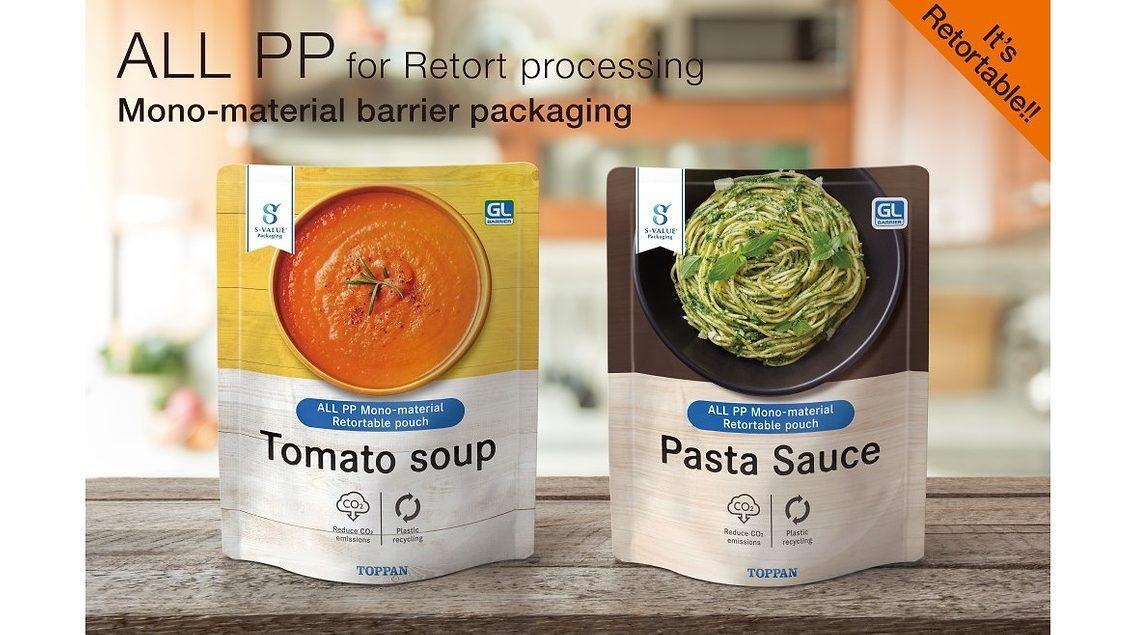
Image Source: Toppan: Mono-material barrier packaging
For further industry insight, TOPPAN's article on mono-material packaging structures and high-barrier performance discusses how packaging manufacturers are developing recyclable flexible packaging while maintaining oxygen and moisture barrier requirements.
For packaging leaders, the priority is to assess the complete package rather than relying on its main material alone.
3. Supporting Packaging Redesign
Mono-material packaging can create opportunities to redesign existing formats that rely on several bonded materials. Flexible films and pouches are relevant examples because manufacturers often need to balance barrier performance, strength, flexibility and sealing requirements.
A redesign may reduce material complexity while retaining the functions required during filling, storage and distribution. However, the new format must still protect the product throughout its expected shelf life.
SP Group's overview of mono-material packaging in the food industry discusses the opportunities and technical challenges involved in developing these structures for food applications.
The business case should therefore consider both the potential recycling benefits and the performance requirements that the redesigned package must meet.
4. Creating Opportunities for Production Efficiency
Packaging changes can also affect manufacturing processes. A redesigned component or material structure may improve compatibility between packaging parts or simplify certain production steps.
However, a material change may require new tooling, adjustments to sealing temperatures, equipment modifications, or additional testing. Packaging leaders should evaluate production performance through trials rather than assume that a simpler material structure will automatically reduce costs.
Shell Polymers' discussion of mono-material packaging provides commercial examples and discusses design and manufacturing considerations.
Before approving a change, businesses should assess production speed, sealing performance, waste rates and the cost of any required equipment modifications.
Challenges of Mono Material Packaging
1. Maintaining Product Protection and Shelf Life
Product protection remains a central requirement when businesses evaluate mono-material packaging. Different materials offer varying levels of resistance to oxygen, moisture, light, heat, and physical damage.
Multi-material structures are often designed to combine several of these properties. Replacing them with a mono-material alternative can require changes to film thickness, material grades, coatings or package design.
Food manufacturers, for example, must ensure that packaging protects product quality throughout storage and distribution. A package that offers better recycling potential but allows the product to deteriorate sooner may increase food waste and undermine the intended environmental benefit.
Packaging leaders should test barrier properties, seal integrity, durability, and shelf life under the conditions the product will encounter.
The Smart Packaging Hub's analysis of mono-material packaging pros and cons provides additional context on the balance between recyclability and packaging functionality.
2. Managing Material and Conversion Costs
The cost of adopting mono-material packaging extends beyond the price of the raw material. Businesses may need to assess new films, coatings, production settings, tooling, supplier specifications, and quality-control requirements.
A redesign may also require packaging trials and validation before manufacturers can introduce it at commercial scale.
These costs should be assessed against the expected benefits. A package that reduces material complexity may offer advantages, but those advantages need to justify any additional investment or changes to production.
IMCD's overview of mono-material packaging in FMCG industries discusses the challenge of improving recyclability while retaining functional performance.
A practical assessment should compare total packaging costs, production output, product protection, and end-of-life requirements rather than focus on material price alone.
3. Verifying Actual Recyclability
A package designed with one main material may still face recycling limitations. Local facilities may not accept the material, or certain components may interfere with sorting and processing.
Packaging leaders should distinguish between a package designed for recycling and one that can be collected and processed through the systems available in its target market.
Businesses should review material specifications, component compatibility, and applicable recycling guidance before making claims about recyclability. Supplier documentation can support this assessment, alongside independent technical evidence and relevant local requirements.
Biszon's overview of mono-material flexible packaging provides an industry perspective on flexible packaging applications and the relationship between material design and recyclable packaging.
How Packaging Leaders Can Assess Mono-Material Packaging
Before approving a material change, packaging leaders should evaluate the proposed design against five practical considerations.
1. Product requirements: Confirm the required shelf life, barrier performance, strength, sealing properties and resistance to handling.
2. Production compatibility: Determine whether existing packaging equipment can process the proposed material at the required speed and quality. Identify any modifications or trials needed before implementation.
3. Total cost: Compare material prices alongside conversion costs, equipment changes, testing, waste rates and potential product losses.
4. Supplier capability: Confirm that suppliers can provide consistent material specifications, sufficient volumes and the technical support required for commercial production.
5. End-of-life performance: Check whether the complete package meets relevant design-for-recycling guidance and whether collection, sorting and recycling facilities can process it in the intended market.
Businesses should also review the existing packaging portfolio to identify applications where a change may deliver meaningful benefits without introducing unnecessary technical risk. High-volume formats may offer opportunities to improve material recovery, but the suitability of each format depends on its product requirements and local recycling options.
This assessment helps businesses determine where mono-material packaging is suitable and where a different format may better meet product and operational requirements.
The objective is not to replace every multi-material package. It is to identify applications where a simpler structure can deliver the required performance while improving the package's prospects for recovery after use.
Applications in Food and Consumer Product Packaging
Food and consumer product packaging provides useful examples of the trade-offs involved in adopting mono-material designs. These applications often require businesses to balance shelf life, product safety, convenience and recyclability.
Flexible films and pouches may be suitable candidates where manufacturers can achieve the required barrier properties and sealing performance using compatible materials. Personal care bottles and other rigid formats may also offer opportunities, although labels, caps, closures and decorative components need to be assessed as part of the complete package.
SP Group's article on mono-material packaging in the food industry explores the technical considerations involved in these applications.
Packaging leaders should assess each format individually rather than assume that one material solution will work across an entire product portfolio. The right design must meet product specifications, manufacturing requirements and the recycling conditions in the markets where it will be sold.
Why Recycling Infrastructure Matters
Even a well-designed recyclable package depends on collection, sorting and processing systems. A package may be technically suitable for recycling but still fail to be recycled if local facilities do not accept it or consumers lack access to appropriate collection services.
This creates an important consideration for businesses selling across multiple regions. A mono-material pouch may be suitable for recycling in a market with established flexible-film collection, but less practical in a market where those materials are not widely recovered.
Packaging leaders should verify local recycling requirements before approving material changes or making recyclability claims. They should also consider how material choices, labels, closures and other components affect compatibility with the intended recycling stream.
The aim is to improve the likelihood of actual material recovery, not simply to design packaging that appears recyclable.
Discuss Packaging Priorities at AmericaPack Summit 2027
Mono-material packaging illustrates a broader challenge for packaging leaders: sustainability objectives must work alongside product protection, production requirements, supplier capabilities and commercial costs.
These decisions benefit from informed discussion between packaging specialists, procurement leaders, operations executives and material suppliers. Comparing experiences can help decision-makers understand which approaches suit their applications and what needs to be validated before implementation.
At the AmericaPack Summit 2027, packaging leaders can exchange perspectives on packaging performance, sustainability priorities and practical approaches to implementation.
Review the AmericaPack Summit 2027 agenda or enquire about attending.
How should businesses decide whether to adopt mono-material packaging?
Businesses should assess product protection, shelf life, production compatibility, total cost, supplier capability and end-of-life requirements. Material trials and technical validation can help confirm whether a proposed design meets commercial and performance requirements.
Strategic Next Steps
Mono-material packaging offers businesses an opportunity to simplify packaging structures and improve their compatibility with recycling systems. However, successful adoption depends on more than selecting a single material.
Packaging leaders must confirm that the proposed design protects the product, performs reliably during production and distribution, meets cost requirements, and can be managed through the available recycling infrastructure.
By evaluating these factors together, businesses can make more informed decisions about mono-material packaging and identify where it can contribute to their wider sustainable packaging objectives.
Frequently Asked Questions
1. What is mono-material packaging?
Mono-material packaging uses one main material type or polymer family instead of combining several different materials in a single structure. It aims to simplify packaging design and may improve compatibility with recycling systems, depending on the complete package and local infrastructure.
2. Is mono-material packaging recyclable?
Mono-material packaging can be designed for recycling, but recyclability is not guaranteed. The material, coatings, inks, adhesives, closures and other components can affect whether facilities can sort and process the package.
3. What are the main benefits of mono-material packaging?
Potential benefits include simpler material structures, improved compatibility with certain recycling processes and opportunities to redesign flexible packaging. Some designs may also improve production efficiency, although outcomes depend on the application and manufacturing process.
5. What are the main challenges of mono-material packaging?
The main challenges include maintaining product protection, achieving the required barrier properties, controlling costs, adapting production equipment, and verifying that suitable recycling systems exist in the target market.