
Sustainable flexible packaging is becoming a board-level priority because it links product protection, brand credibility, compliance readiness, and material efficiency. For executive leaders, the central issue is not whether packaging should become more sustainable, but how to select solutions that protect margins, meet performance requirements, and support measurable environmental objectives.
Companies must therefore assess sustainable packaging solutions based on commercial value, operational requirements, and regulatory compliance, rather than on design preference alone. These exact priorities are currently being discussed by senior executives at the Europack Summit 2027.
What makes flexible packaging sustainable?
Flexible packaging becomes sustainable when it reduces environmental impact while continuing to protect the product, preserve shelf life, support safe distribution, and fit within credible recovery pathways. This requires disciplined material selection, packaging design, supplier qualification, and clear end-of-life instructions for customers and recyclers. EY has emphasized that a sustainable flexible plastic packaging strategy requires companies to consider business model, material choices, regulatory exposure, and consumer expectations together rather than treating packaging as an isolated procurement decision.
For many companies, flexible formats offer practical advantages compared with heavier rigid formats, including lower material use, efficient transportation, and strong product-to-package ratios. However, companies may lose these benefits if collection, sorting, recycling, composting, or other responsible waste-management systems cannot handle the package. The strongest strategies therefore address the full lifecycle, from resin or fiber sourcing through converting, filling, distribution, use, and disposal.
Executives should also avoid assuming that one material will solve every packaging challenge. Food, personal care, healthcare, household products, and industrial goods each require different barrier properties, sealing performance, print requirements, and safety considerations. The most effective sustainable flexible packaging programs begin with a clear definition of performance needs, then reduce unnecessary complexity while preserving product integrity.
Material innovation is redefining performance
A major area of progress is the development of recyclable mono-material structures. Traditional flexible packaging often combines different layers, such as plastics, foil, paper, adhesives, and coatings, to achieve barrier, strength, print, and sealing performance. These combinations can perform well during use, but recyclers may struggle to recycle them because they must separate the different material layers.
Industry coverage also highlights the challenges involved in developing sustainable flexible packaging materials, particularly the need to balance material performance with practical packaging requirements. Label & Narrow Web examines sustainable flexible packaging materials, current trends and industry challenges.
Mono-material packaging addresses this concern by using layers from the same general material family, making recycling more practical where collection and processing systems exist. TOPPAN describes mono-material barrier packaging as an approach that applies barrier technologies to PP, PE, PET, and paper-based structures, enabling flexible packaging that combines protection with improved environmental suitability.
TraceX also explains that mono-material packaging simplifies recycling by reducing the complexity of mixed-material structures. For executives, the implication is clear: packaging redesign should not only reduce material weight but also make materials easier to identify, process, and recover.
Key material pathways include:
- Mono-material films: Structures based primarily on PE, PP, or PET to support recyclability where suitable infrastructure is available.
- Barrier coatings: Thin coatings that help protect products from oxygen, moisture, aroma loss, or contamination without relying on complex laminates.
- Recycled content: Post-consumer or post-industrial recycled inputs, where allowed by regulation and suitable for the product category.
- Bio-based materials: Materials derived from renewable feedstocks, subject to performance, land-use, certification, and end-of-life assessment.
- Compostable formats: Companies should target applications where certified composting facilities are readily available, and they can manage contamination risks effectively.
Each pathway has trade-offs. A lighter pack may reduce transportation impact, but if it compromises product protection, the resulting product waste may outweigh the packaging benefit. Similarly, a recyclable structure must still be commercially viable and compatible with filling lines, logistics conditions, consumer use, and available recovery systems.
Recent industry discussions also examine developments in flexible packaging materials and technologies, including the challenge of maintaining product protection while improving sustainability. H.B. Fuller outlines flexible packaging trends for 2026, offering an additional industry perspective on these developments.
Why should executives treat packaging as a strategic asset?
Packaging influences cost, risk, brand position, regulatory compliance, and customer trust, which makes it a strategic asset rather than a technical afterthought.
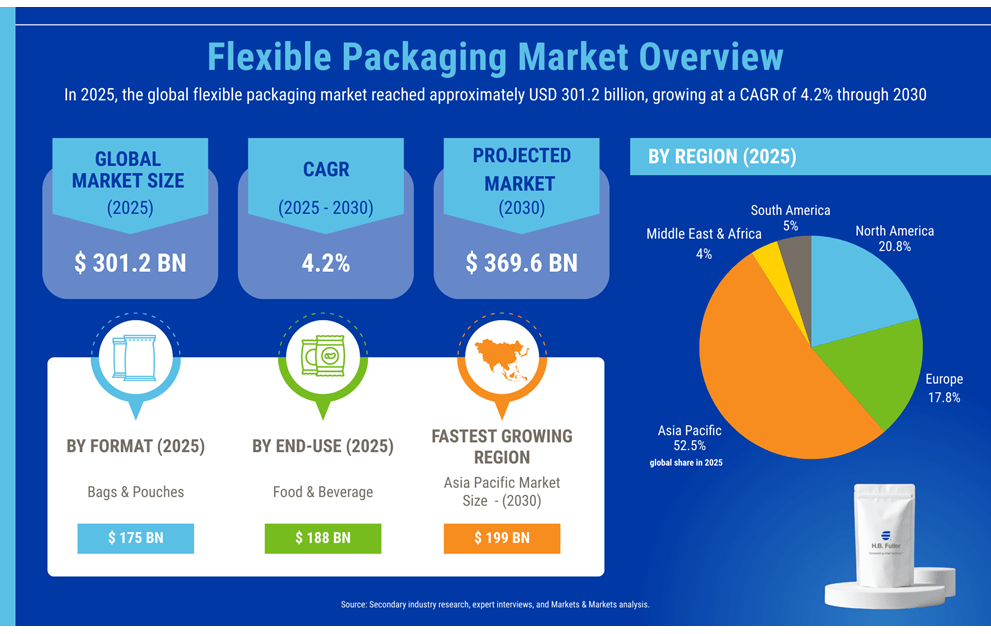
Image Source: Flexible Packaging Market Overview | H.B. Fuller
This image comes from H.B. Fuller’s content titled Flexible Packaging Market Overview. It is used as a visual reference to support information about the flexible packaging industry, such as market trends, common materials, key applications, and factors influencing packaging performance and sustainability. H.B. Fuller, a company known for adhesives and packaging solutions, provides this overview to explain how flexible packaging is evolving and what manufacturers and brand owners should consider when selecting structures, seals, and bonding technologies.
Decisions made at the packaging specification stage can affect procurement flexibility, supplier concentration, production efficiency, claim substantiation, and market access. A packaging format that performs well today but cannot adapt to future regulatory or retailer expectations may create avoidable costs later.
A strategic approach starts with governance. Sustainability, procurement, research and development, operations, marketing, legal, and finance should evaluate packaging decisions through a shared framework. This prevents isolated decisions, such as approving a material for brand appeal without confirming recyclability claims, line compatibility, or regional compliance requirements.
Sustainable flexible packaging generally uses renewable, recyclable, biodegradable, or lower-impact materials while maintaining product integrity and safety. Although executives should validate market data through primary research, the core principle remains sound: companies must protect product safety, quality, and functionality when pursuing sustainability.
A leadership-level assessment should include:
- Material performance: Does the structure protect the product across its required shelf life and distribution route?
- Regulatory fit: Are claims, labels, recycled-content levels, and end-of-life instructions compliant in each market?
- Operational impact: Will the material run efficiently on existing equipment, or will the company need to invest in new equipment?
- Supplier capability: Can suppliers provide consistent quality, documentation, and traceability?
- End-of-life reality: Is the package recyclable, compostable, or recoverable in practice, not only in theory?
- Commercial value: Does the change support customer preference, retailer requirements, margin protection, or risk reduction?
This framework helps leaders distinguish meaningful progress from cosmetic changes. It also helps companies allocate capital more effectively by prioritizing projects according to feasibility, impact, and strategic relevance.
Design principles that convert intent into results
A successful Sustainable packaging solution depends on design discipline. The objective is to remove avoidable material and complexity while retaining the properties that matter most. Packaging teams must work closely with suppliers and manufacturing leaders before approving final specifications.
Design for reduction is often the first step. Gauge optimization, right-sizing, and improved pack geometry can reduce material demand without changing the overall format. However, companies should test material reductions carefully to ensure adequate puncture resistance, seal strength, drop performance, shelf life, and protection under transport conditions.
Design for recovery is equally important. If companies intend to recycle the packaging, they should design its structure to support sorting and processing. That may mean limiting incompatible layers, selecting detectable materials, choosing adhesives and inks with care, and providing disposal guidance that consumers can understand.
Executives should also demand credible documentation. Companies should substantiate sustainability claims with recognized testing, supplier declarations, lifecycle assessments, and market-specific regulatory reviews. Claims that are vague or difficult to verify can create legal and reputational exposure.
Implementation requires cross-functional execution
The transition to sustainable flexible packaging should be managed as an enterprise program. Packaging touches product development, brand management, manufacturing, supplier contracts, logistics, sustainability reporting, and customer communication. Without cross-functional ownership, promising concepts may fail during scale-up.
A practical implementation roadmap includes:
- Portfolio mapping: Identify the highest-volume, highest-risk, and most visible packaging formats first.
- Specification review: Document current materials, layers, weights, suppliers, performance needs, and end-of-life claims.
- Opportunity ranking: Prioritize formats where material simplification, recycled content, or redesign can create measurable value.
- Pilot testing: Validate machinability, product protection, shelf life, consumer usability, and retailer acceptance.
- Commercial modeling: Assess material cost, conversion cost, capital needs, waste reduction, logistics effects, and margin impact.
- Claim governance: Review all on-pack and marketing claims with legal, regulatory, and sustainability teams.
- Supplier development: Build long-term relationships with converters and material providers that can support documentation and scale.
Industry collaboration accelerates progress
Sustainable packaging goals cannot be achieved by brand owners alone. Material suppliers, converters, equipment providers, retailers, recyclers, regulators, and industry associations all influence what is possible. This is especially true for flexible packaging, where end-of-life outcomes depend heavily on collection, sorting, and processing capability in specific markets.
For leaders seeking high-level dialogue with senior packaging, procurement, and sustainability decision-makers, the EuroPack Summit 2027 offers a relevant forum to examine packaging priorities, supplier relationships, and innovation opportunities.
View Agenda | Enquire about the event
Executive takeaway
Material innovation, practical end-of-life design, stronger data governance, and closer value-chain collaboration will shape the future of flexible packaging. Sustainable flexible packaging is not a single product category or a marketing claim. It is a management approach that aligns product protection, environmental responsibility, regulatory readiness, and commercial performance.
Leaders who act now can build packaging portfolios that are more efficient, better documented, and better prepared for customer and regulatory scrutiny. The strongest programs combine technical rigour with executive sponsorship, enabling companies to translate sustainability commitments into packaging decisions that perform in the market and withstand scrutiny.
Frequently Asked Questions
What is sustainable flexible packaging?
Sustainable flexible packaging refers to packaging formats such as films, pouches and wraps designed to reduce environmental impact while protecting products. Relevant considerations include material efficiency, recyclability, responsible material sourcing, production requirements and end-of-life management.
Why is sustainable flexible packaging important in Europe?
European packaging businesses must consider environmental objectives alongside the requirements of the PPWR and applicable national rules. Flexible packaging redesign can help address material use and recyclability, provided that alternatives meet product protection and performance requirements.
Is mono-material flexible packaging always recyclable?
No. Mono-material structures can simplify recycling compared with some mixed-material formats, but recyclability depends on the complete packaging design and the collection, sorting and recycling systems available. Businesses should verify performance in their target markets rather than assume that a single-material structure guarantees recyclability.
How does the PPWR affect flexible packaging?
The PPWR establishes requirements for packaging placed on the EU market, including provisions on recyclability, packaging minimisation, recycled content and labelling. Requirements and deadlines vary by provision, so businesses should consult the regulation and current European Commission guidance to determine which obligations apply to their products.
How can companies evaluate a Sustainable packaging solution?
Companies should compare environmental impact, recyclability, material cost, product protection, manufacturing compatibility and supplier capabilities. Testing under real production and distribution conditions helps confirm whether an alternative meets the required performance standards.
What should packaging leaders assess before changing materials?
Packaging leaders should review regulatory requirements, barrier performance, shelf life, seal integrity, production-line compatibility, supplier availability and total cost. Trials and measurable performance criteria help reduce the risk of introducing a material that creates problems elsewhere in the supply chain.