.jpg?width=50&name=Shobana_Anpalagan_Profile%20(1).jpg)
In a clinical setting, an outdated or generic appraisal system does more than just frustrate HR; it actively contributes to staff burnout, scheduling conflicts, and dangerous data silos during compliance audits. Modernizing your review infrastructure is one of the most effective retention strategies a healthcare facility can make.
By shifting away from administrative box-checking and toward structured, continuous feedback, organizations can build a workplace culture that improves both staff fulfillment and patient care.

Image Source: Freepik.com
Below are the industry-vetted best practices for healthcare hr management to optimize your workflows.
1. Optimize the Length and Structure of Your Reviews
Many healthcare networks overwhelm their staff with endless, generic review templates. The PerformYard State of Healthcare Performance Management Report reveals that organizations achieve an impressive review completion rate of 95.44% when they limit forms to 15–20 total questions. When forms drag on longer, clinical staff experience "appraisal fatigue," leading to rushed, low-quality answers just to get the task over with.
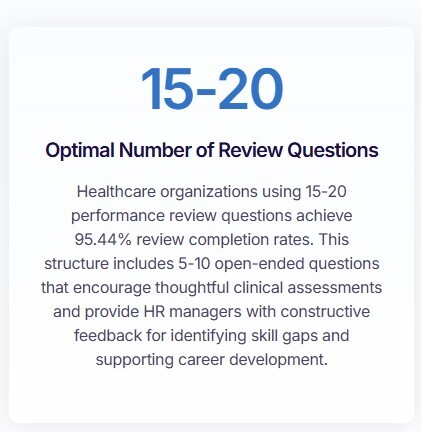
Image Source: PerformYard State of Healthcare Performance Management Report
Balancing Metrics with Nuance
Within that 15–20 question limit, striking the right balance between quantitative metrics and qualitative feedback is essential. Relying solely on numerical rating scales completely misses the human element required in clinical care.
Actionable Step: Restrict your quantitative ratings to core operational requirements and dedicate room for exactly 5–10 open-ended, text-based questions. This specific structure enables a deeper, more nuanced clinical assessment of critical soft skills, such as bedside empathy, family communication during crises, and split-second problem-solving under pressure, that strict numerical scales fail to capture.
2. Implement Highly Focused, Competency-Based Goals
Vague or overloaded goal-setting leaves clinical staff feeling directionless, which directly threatens patient safety and increases compliance risks. Data indicates that 86.4% of top-performing healthcare organizations limit goals to just 1–5 per employee, focusing exclusively on core clinical competencies rather than general performance ideas.
Differentiating Clinical vs. Non-Clinical Metrics
A common mistake in hospital systems is applying a single review framework across the entire payroll. To make goals meaningful, HR leaders must separate expectations based on role functionality:
Clinical Staff (Nurses, Physicians, Techs)
- Focus Metrics: Patient safety, clinical compliance, care accuracy, and bedside manner.
- Example KPI: Reducing patient readmission rates or decreasing medication administration errors by a specific percentage.
Non-Clinical Staff (Admissions, Billing, Facilities)
- Focus Metrics: Operational efficiency, revenue cycle health, and patient processing speed.
- Example KPI: Accelerating patient intake times or reducing billing code discrepancies by a specific percentage.
Actionable Step: Ensure every individual goal directly ties into measurable, hospital-wide success metrics. When a nurse understands how their personal accuracy impacts the unit's overall HCAHPS (Hospital Consumer Assessment of Healthcare Providers and Systems) satisfaction scores, they feel a stronger sense of ownership over their daily outcomes.
3. Manage Spans of Control to Boost Achievement
Healthcare managers routinely face an immense administrative burden, managing an average of 10.6 direct reports; a staggering 68% higher than the all-industry average.
- Actionable Step: Where structurally possible, adjust internal unit hierarchies to aim for 5–10 direct reports per manager. Healthcare teams operating within this tighter span achieve an 85% goal completion rate because unit leaders have the bandwidth to provide actual clinical supervision and meaningful development check-ins.
4. Unify Your Strategy Under Healthcare Human Capital Management
True performance optimization requires connecting your short-term review cycles directly to long-term employee growth trajectories. Organizations should never treat performance reviews as isolated, once-a-year administrative events; instead, they must use them as a foundational piece of their overall healthcare human capital management strategy..
Building Internal Leadership Pipelines
High turnover among specialized clinical staff is one of the most expensive challenges hospital systems face today. One of the primary reasons frontline workers resign is a perceived lack of professional upward mobility.
- Actionable Step: According to research on frontline leadership by the American Organization for Nursing Leadership (AONL), expanding a manager's role without clear career pathway support directly triggers turnover. Use regular milestone tracking to identify top-performing floor nurses and technicians early, funneling them into leadership tracks to stabilize your workforce. By intentionally funneling these high-potential individuals into a formal healthcare leadership development program, you protect your talent investments and build a sustainable, internal succession pipeline.
5. Centralize Compliance and Audit Readiness
Healthcare HR teams carry an intense documentation and regulatory burden that regular, generic corporate HR platforms simply aren't engineered to handle. Leaving critical items like active licensure tracking, mandatory CEUs (Continuing Education Units), and credentialing records scattered across individual shared drives, physical file cabinets, and disconnected spreadsheets creates massive regulatory vulnerabilities.
Automating the Audit Trail
During an unannounced regulatory inspection, scrambling to find manual paperwork can result in catastrophic compliance failures or massive fines. Performance management and compliance verification should happen in the same workspace.
- Actionable Step: Leverage dedicated hr software solutions for the healthcare industry to automatically log every performance milestone, performance improvement plan (PIP), and credential renewal as an immutable, securely structured record. When a Joint Commission audit or credentialing inquiry occurs, your HR team shouldn't have to spend days collecting files; they should be able to instantly generate a complete compliance history with zero manual data-gathering.
Driving Culture from the Top Down
Transitioning from a reactive, check-the-box review process to a continuous, data-driven performance management system does more than just clear up administrative headaches for HR teams. It builds foundational trust on the hospital floor, prevents compliance leaks before they result in fines, and highlights employee disengagement long before it turns into a resignation letter.
By implementing specialized software systems, clinical teams can easily complete evaluations asynchronously around their demanding, rotating shift schedules. Ultimately, these structural upgrades allow healthcare systems to protect their bottom line while keeping their primary focus exactly where it belongs: on providing safe, exceptional patient care.
Join the Conversation
Ready to dive deeper into the future of healthcare workplace strategy? Come join us at the Healthcare HR Summit 2026, where industry leaders will be discussing and unlocking top-tier insights about modern HR operations and key industry agendas. If you want to connect with peers and elevate your institutional workflows, visit the Marcus Evans Healthcare HR Summit page and learn more about the event or submit an enquiry today.
Frequently Asked Questions (FAQs)
1. How often should performance reviews be conducted in a healthcare setting? While traditional corporate environments often rely on annual appraisals, healthcare settings benefit significantly from a continuous feedback model. Best practices suggest conducting lightweight, role-specific check-ins quarterly or bi-weekly. This pace matches changing clinical protocols, spots burnout signs early, and tracks staff compliance and training needs in real time.
2. How do you measure the performance of a clinical employee fairly? Fair clinical performance measurement relies heavily on role-specific, objective KPIs rather than generic evaluation forms. For nurses and physicians, metrics should be tied strictly to patient care quality, compliance accuracy, and clinical protocols (such as medication error rates or HCAHPS patient satisfaction scores).
Additionally, qualitative open-ended questions must be included to fairly capture essential soft skills like bedside empathy and crisis communication.
3. What is the average span of control for a healthcare manager, and why does it matter? Data shows that healthcare managers routinely oversee an average of 10.6 direct reports, which is roughly 68% higher than managers in other industries. Managing too many employees dilutes the quality of feedback and oversight. Optimizing this ratio down to 5–10 direct reports per unit leader dramatically improves goal completion rates and allows managers the necessary bandwidth to provide proper clinical supervision and prevent staff burnout.
4. Why are standard corporate HR platforms insufficient for healthcare organizations? Standard corporate HR software is designed for linear office environments and does not provide the structural capabilities needed to manage hospital staff. Healthcare networks require specialized systems that can handle asynchronous data collection across rotating 24-hour shifts, track complex clinical competencies, and centralize continuous compliance documents like licensures, certifications, and mandatory CEUs for audit readiness.