.jpg?width=50&name=Shobana_Anpalagan_Profile%20(1).jpg)

When a hospital needs to save money, the first instinct is often to make sudden, painful cuts....
Health systems are operating under extreme financial pressure. Rising labor costs, ongoing supply chain inflation, and frequent claim denials from payers have pushed operating margins down. Traditional cost-cutting measures, like across-the-board layoffs or delaying critical capital investments, are no longer workable options, as they directly threaten patient outcomes and worsen staff burnout.
Handling these financial pressures requires a clear operational change. Effective healthcare cost containment focuses on removing daily friction, reducing unnecessary clinical variation, and making full use of digital tools. By building efficiency directly into administrative and clinical routines, health system CFOs can protect cash reserves without compromising patient care.
Executive Leadership Perspective: Aligning C-Suite Strategy
While finance teams drive short-term margin protection, lasting cost control requires leadership across all departments. CFOs, finance directors, and executive teams are reshaping daily operations, staffing models, and vendor partnerships to protect long-term solvency.
Healthcare CFOs and senior financial executives will convene at the Healthcare CFO Financial Strategy & Revenue Cycle Management Summit 2026 to discuss operational resilience, revenue cycle transformation, and margin defense strategies.
1. Administrative Automation & Revenue Protection
Administrative overhead remains one of the largest sources of capital leakage across health systems. Manual data entry during registration, inefficient eligibility checks, and labor-intensive claims management significantly inflate the total cost to collect.
Moving away from manual workflows to intelligent automated systems is critical to stabilizing financial performance. Automating front-end eligibility verification prevents downstream clean-claim rejections, while machine-learning claim scrubbers flag contract discrepancies before submission. As explored in our detailed guide on effective RCM automation tools in healthcare, deploying automated orchestration layers within existing Electronic Health Record (EHR) environments directly limits operational expenditure and accelerates cash realization.
Realigning front-end registration workflows and deploying intelligent pre-submission claim scrubbers dramatically cuts administrative cost-to-collect while improving clean-claim submission rates." - Shannan Bolton, VP of Revenue Cycle Optimization at Stanford Health Care (Featured Speaker, Healthcare CFO Financial Strategy & Revenue Cycle Management Summit 2026)"
2. Clinical Workflow & Care Standardization
Unnecessary clinical variation directly inflates care delivery costs and creates operational bottlenecks. When clinical teams lack instant access to standardized, evidence-based care guidelines at the point of care, health systems experience higher rates of avoidable complications, extended lengths of stay, and administrative rework.
Enhancing operational efficiency in healthcare requires equipping clinicians with centralized decision-support platforms and real-time data mobilization. Insights from the American Hospital Association (AHA) demonstrate how mobilizing core clinical and operational data sets across health systems reduces care coordination friction, streamlines patient flow, and eliminates redundant administrative tasks for care teams. Standardizing clinical pathways and unlocking data accessibility minimizes care variability, saves valuable physician time, and translates directly into structural cost savings.
3. Supply Chain Optimization & Inventory Control
Healthcare supply chains represent a substantial portion of an organization’s operating budget, yet many systems still rely on fragmented procurement platforms and disconnected legacy software. This lack of integration leads to inventory bloat, product expiration waste, and off-contract purchasing.
To achieve sustainable cost containment, health systems must integrate modern Enterprise Resource Planning (ERP) frameworks. Utilizing platforms like NetSuite provides finance leaders with real-time visibility into inventory levels, automated reorder points, and enterprise-wide spend management analytics. Centralizing procurement data allows organizations to negotiate bulk purchasing agreements, eliminate stock redundancy, and align clinical material usage directly with overall budget goals.
4. Strategic Workforce Management & Retention
Managing labor volatility continues to be a primary financial challenge for hospital administrators. Over-reliance on expensive agency staffing to cover coverage gaps severely degrades operating margins, while administrative burdens accelerate clinical burnout and turnover.
According to industry frameworks on workforce cost management from Health Carousel, proactive retention strategies, such as automated shift scheduling and administrative burden reduction, are essential for lowering agency dependency and stabilizing baseline operational spend.
Staffing & Scheduling
- Traditional Approach: Reactive, manual shift-filling
- Modern Cost Containment Strategy: Predictive analytics matching patient acuity to nurse hours
Agency Labor Usage
- Traditional Approach: High reliance on costly premium contract staffing
- Modern Cost Containment Strategy: Strategic float pools and automated shift-bidding platforms
Clinical Administrative Load
- Traditional Approach: Manual chart management and protocol lookup
- Modern Cost Containment Strategy: Streamlined digital workflows reducing administrative burnout
5. Managing Commercial Rates & Value-Based Care Models
Securing long-term fiscal health requires CFOs to look beyond internal operations and address external reimbursement changes. As state governments and commercial payers implement stricter cost-growth benchmarks, health systems must adapt their contracting and care models.
Comprehensive state-level analyses from The Commonwealth Fund highlight how progressive health systems are adjusting commercial market strategies to stay viable under tightening rate caps. Aligning operational models with value-based care frameworks allows providers to earn financial performance incentives by lowering the total cost of care while maintaining high clinical quality standards.
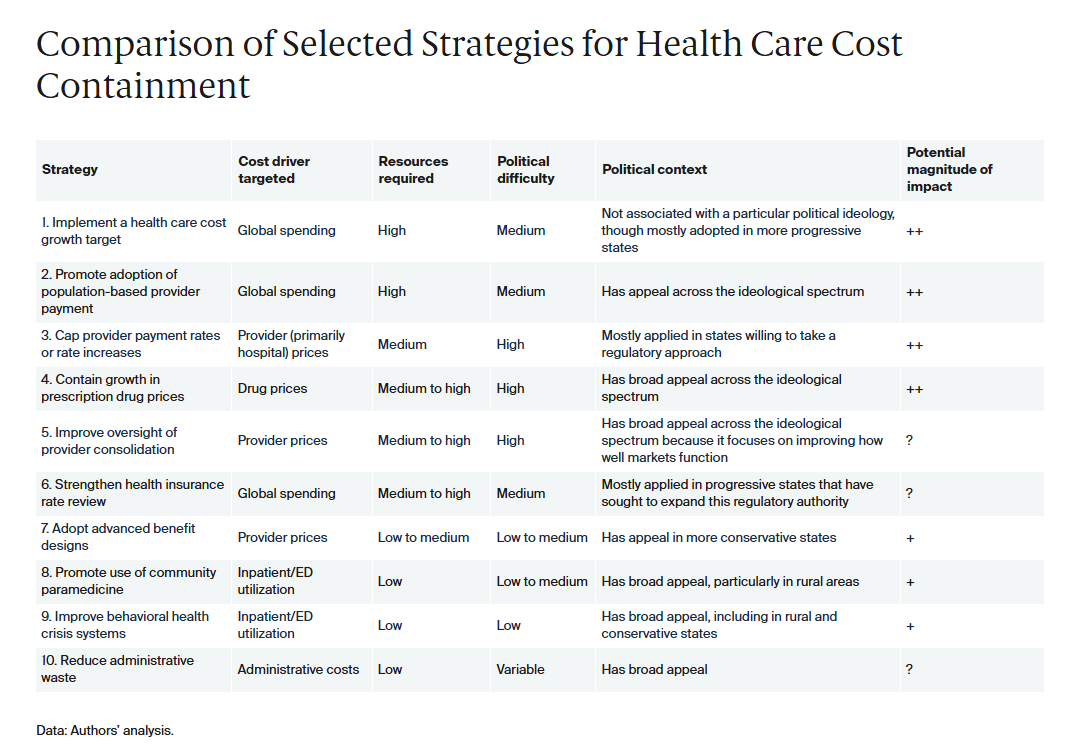
Image Source: Ann Hwang et al., State Strategies for Slowing Health Care Cost Growth in the Commercial Market (Commonwealth Fund, Feb. 2022).
Implementing robust cost containment strategies in healthcare requires aligning financial vision with operational execution. This October, executive finance leaders, hospital administrators, and pioneering technology providers will assemble in Las Vegas for an exclusive interactive event.
The Healthcare CFO, Financial Strategy & Revenue Cycle Summit 2026 offers a focused, invitation-only setting for hospital leaders to benchmark strategies, share actionable solutions, and address persistent margin pressures.
Key Summit Discussion Pillars:
- Cost Volatility & Margin Defense: Mitigating inflation, managing site neutrality, and controlling operational spend.
- AI-Powered Health Systems: Leveraging digital automation to optimize administrative workflows and clinical productivity.
- Re-Engineering Payer Alignment: Strengthening contract negotiations and minimizing claim denials.
Explore the official Healthcare CFO, Financial Strategy & Revenue Cycle Summit 2026 Agenda to review session details, or Enquire Now for Invitation Details to reserve your place among executive peers.
Frequently Asked Questions (FAQs)
1. How can hospital CFOs control costs without negatively impacting patient care? Sustainable cost containment targets operational waste rather than clinical resources. Automating administrative tasks, standardizing supply chain procurement, and reducing clinical care variations lower operating overhead while preserving patient safety and clinical quality.
2. Which metrics best track operational efficiency in healthcare? Key performance indicators (KPIs) include Days in Accounts Receivable (A/R), clean-claim submission rates, cost-to-collect percentage, clinical supply cost per discharge, staff turnover rates, and agency labor expenditure.
3. What is the expected ROI timeline for operational automation initiatives? Many health systems observe measurable ROI within 30 to 90 days of implementing focused automation tools, particularly in front-end eligibility verification, denial management, and digital scheduling workflows.
4. How does value-based care contribute to long-term cost containment strategies in healthcare? Value-based care changes the focus from patient volume to patient outcomes, directly reducing expensive hospital readmissions, emergency department overcrowding, and redundant diagnostic testing. Aligning care delivery with quality metrics allows health systems to secure financial performance bonuses while lowering the total cost of care.
5. What role does supply chain standardization play in improving operational efficiency in healthcare? Standardizing clinical supplies and preference cards reduces inventory bloat, minimizes product waste from expiration, and strengthens vendor negotiation leverage. Gaining real-time inventory visibility enables systems to eliminate off-contract spend without compromising clinical choice or patient care.
6. How can healthcare systems address high workforce costs without causing staff burnout? Deploying predictive scheduling platforms matches nurse shifts to real-time patient acuity, preventing overstaffing while protecting staff-to-patient ratios. Automating routine administrative tasks further reduces administrative fatigue, helping hospitals decrease costly agency labor reliance and improve retention.