
.jpg?width=50&name=Shobana_Anpalagan_Profile%20(1).jpg)

In 2026, workforce availability isn't just an HR topic; it dictates how health systems set budgets,...
Strategic healthcare workforce management has changed from a routine administrative task to a critical pillar of hospital profitability.
A recent analysis by Becker’s Hospital Review on the 2026 NSI National Health Care Retention & RN Staffing Report highlights a massive financial leak: the average hospital now loses roughly $5.19 million annually to nurse churn. With the cost of replacing a single bedside RN reaching over $60,000, unmanaged turnover has become a direct threat to operational survival.
Patient volumes fluctuate too much for last year's templates. Because of this volatility, overworked teams are leaving faster than they can be replaced.
This article breaks down how forward-thinking health systems are rebuilding their staffing strategies from the ground up and where executives can go to compare notes on what is actually working.

Image source: Freepik
Why Is Predictive Scheduling Replacing the Old Staffing Playbook?
Most hospitals still build schedules around a familiar baseline: last year's averages, adjusted slightly for season. That approach is breaking down. Acuity is rising, outpatient volumes are changing unevenly, and a single bad flu season or local outbreak can blow a static schedule apart within days, forcing managers to fill the gap with expensive last-minute agency staff.
Labor is already hospitals' single largest expense category, and the American Hospital Association's 2026 Costs of Caring report found that workforce costs kept climbing even as overall hospital expense growth slowed. Against that backdrop, health systems with strong healthcare leadership are responding by moving from reactive staffing to predictive scheduling.
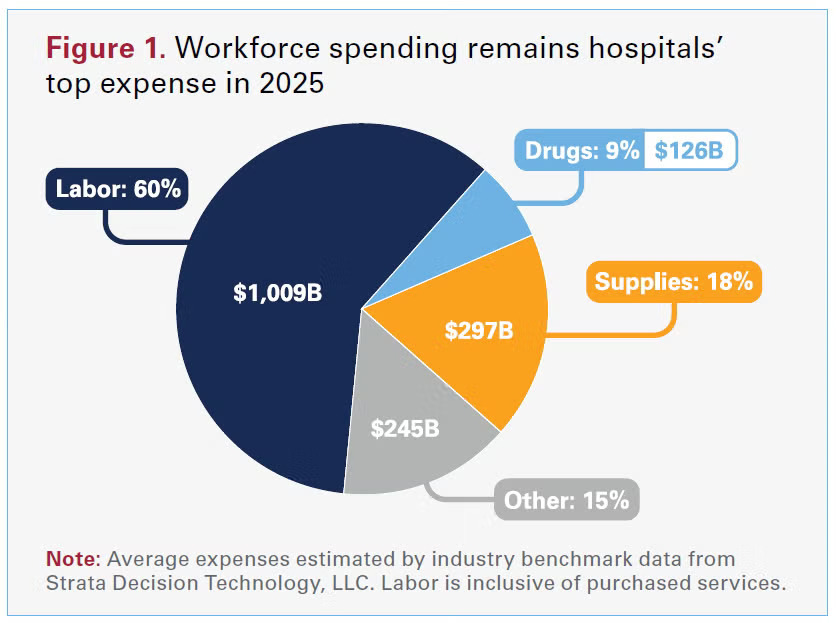
Image Source: American Hospital Association
Rather than reacting once a unit is already short, they use AI-powered predictive analytics to forecast patient influxes 30 to 60 days out, drawing on admissions trends, seasonal patterns, and regional health data.
That lead time lets leaders scale up internal staffing or extend per diem offers before a surge hits, instead of paying three times the standard rate for emergency travel coverage once the unit is already underwater.
The goal is not eliminating variability in demand, but giving leadership enough runway to absorb it without bleeding margin every time volume spikes.
What Is the Real Cost of Manual Workforce Administration?
Even hospitals with solid scheduling still lose money to a quieter problem: the administrative weight of running a modern nursing workforce.
Credentialing, license verification, background checks, and shift coverage are still tracked manually at many facilities, spread across spreadsheets, shared drives, and email threads.
Here is what that friction actually costs, based on industry benchmarks:
- Nurse managers lose hundreds of hours a year to manual compliance and credential tracking
- Standard time-to-fill for a nursing role still averages close to 90 days at many hospitals
- Each percentage point increase in RN turnover adds hundreds of thousands of dollars in hiring and onboarding costs, according to Becker's Hospital Review analysis of the 2026 NSI retention report
- Hospitals running an integrated digital workforce platform have compressed that 90-day hiring lag down to days
A unified Healthcare Workforce OS Stack, a single platform combining scheduling, credentialing, and compliance, is how leading systems are closing this gap and converting administrative drag into recovered margin.
How Can Hospitals Build a More Resilient Nursing Workforce?
Beyond technology, hospitals need a strategy that matches what today's nursing workforce actually wants: flexibility and control, not just a paycheck.
1. Build an internal float pool
Give nurses a single app where they can see open shifts across the entire system and pick up extra hours on their own schedule, rather than losing that flexibility to an outside staffing agency.
2. Add real-time incentive pay
Post hard-to-fill or last-minute shifts with visible bonuses attached, so a nurse can open the app and claim a high-paying shift in minutes, keeping that capacity inside the network instead of paying an agency markup for it.
3. Treat retention data as a financial metric
Track turnover and time-to-fill alongside revenue and labor cost, not buried in a separate HR report, so workforce strategy gets reviewed with the same rigor as any other line on the P&L.
This same workforce-as-financial-metric mindset runs through Marcus Evans' broader healthcare summit content, including the Healthcare CMO Summit's workforce planning playbook, which looks at how clinical leaders are tackling burnout and staffing structurally rather than department by department.
Bring This Strategy to the C-Suite
Solving healthcare workforce management at the source means more than a single hospital's policy change. It requires hospital leaders to compare data and strategy directly with their peers.
The Healthcare CEO & Executive Strategy Summit, widely known among attendees as the Hospital C-suite Summit 2026, takes place October 19 to 20, 2026, in Las Vegas, Nevada, bringing together senior healthcare executives to work through exactly these staffing and margin challenges.
Frequently Asked Questions
What is healthcare workforce management?
Healthcare workforce management is the practice of scheduling, deploying, and retaining clinical staff in a way that matches patient demand while controlling labor costs and burnout.
Why is nurse turnover so expensive for hospitals?
Replacing a bedside RN involves recruitment, onboarding, lost productivity, and temporary coverage costs that together can exceed $60,000 per departure.
What is a Healthcare Workforce OS Stack?
It is a unified platform that combines scheduling, credentialing, compliance tracking, and shift coverage into one system instead of separate manual processes.
How can hospitals reduce reliance on travel nurses?
By building internal float pools with app-based shift claiming and real-time incentive pay, giving staff nurses the flexibility they would otherwise seek from an agency.